Meme coin trading on a $10 budget
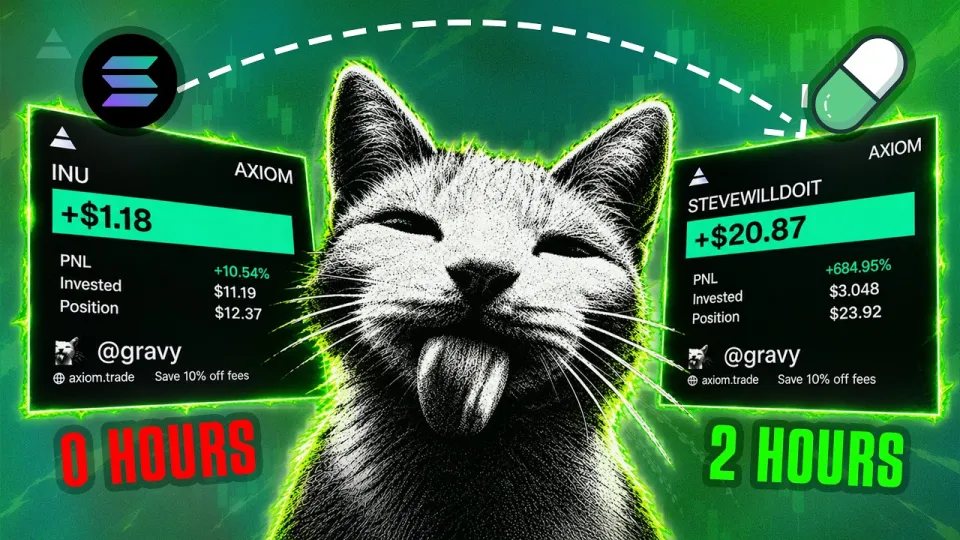
Video: I Tried Trading Memecoins with Just $10
Need articles like this for your video? They help promote it on YouTube and Google — order them in the Telegram bot @sat_sit_bot. It writes articles around your video, embeds the video and publishes them on popular niche websites (no ads). Free trial — 50 articles.
Key takeaways
- Five real meme coin trades were made on Solana, each buy under 0.05 SOL — roughly $10 per position at SOL prices near $200.
- The coins traded were STEVEWILLDOIT, NPC, MET (Meteora), PUMPY the Trader and UNTXD, all routed through the Axiom trading terminal.
- The X Money meta (e/acc, Cream) is cited as the narrative driver behind one of the entries.
- Fees and slippage on Solana are small in absolute terms but large in percentage terms on a 0.05 SOL position — that is the core constraint of small-portfolio trading.
- The host fumbled one exit badly and admits it; the video ends with a poll on live trading a doxxed wallet from 0.1 SOL or 1 SOL.
Meme coin trading with a $10 portfolio is possible on Solana, but only if you treat fees, slippage and narrative timing as the main variables rather than the coin itself. A five-trade experiment routing every buy through Axiom's trading terminal kept each position under 0.05 SOL, and the results show that small size changes the strategy far more than it changes the market.
That is the premise of a breakdown published by the channel gravy, which walks through each entry and exit rather than showing a PnL screenshot. The value for anyone with a small balance is in the mechanics: how much a 0.05 SOL buy really costs, why narrative coins move, and where a retail trader with ten dollars structurally loses.
What a $10 meme coin portfolio actually means on Solana
A $10 meme coin position on Solana is a 0.05 SOL buy, and at SOL prices in the low hundreds of dollars that leaves almost no room for error. Every trade carries a fixed cost stack: the platform fee on the router, the priority fee paid to land the transaction, the liquidity provider fee inside the pool, and slippage between the quoted and executed price.
On a $1,000 position those costs are rounding errors. On a $10 position they are the difference between a green trade and a red one. A 1% platform fee plus 0.5% slippage plus a priority fee of a few cents can easily consume 3–6% of the position before the price has moved at all. That is the honest answer to the question of whether small portfolios can trade meme coins: they can, but every trade starts several percent underwater and needs a real move to recover.
The practical consequences for a small balance are:
- Position count matters more than position size — five $10 trades cost five times the fixed fees of one $50 trade.
- Exits must be planned before entry, because a 20% drawdown on a $10 position is $2 and most people will not bother to sell for $2, which is exactly how small losses become total losses.
- Only coins with an active narrative are worth the fee drag, since a coin that chops sideways guarantees a loss after costs.
The five trades: STEVEWILLDOIT, NPC, MET, PUMPY and UNTXD
The five trades in the experiment each had a stated reason for entry, and the reasons are more instructive than the tickers. STEVEWILLDOIT was the opening trade, a classic "Steve will do it" style meme built on a known internet personality. NPC followed, riding the broad NPC/ai16z-adjacent meme wave where the joke itself is the product. MET referred to Meteora, a Solana liquidity protocol whose token and surrounding memes attract traders who already understand the ecosystem. PUMPY the Trader was a meta play on the pump.fun launch culture itself. UNTXD was the last entry and the one the host describes as badly mishandled.
The X Money meta — tied to e/acc and the Cream crowd — is the clearest example of how these narratives form. A single influential account posting about a coin, a token launchpad making deployment free, and a timeline that rewards speed over diligence produce a window of a few hours in which a coin can run hundreds of percent. Traders with small balances are not competing on information; they are competing on reaction time and on knowing which accounts actually move price.
The uncomfortable detail is the fumbled trade. The host is explicit that one exit was botched, and that admission is worth more than the winning trades. On a 0.05 SOL position, hesitation is not a psychological problem, it is a mathematical one: the spread and fees mean a coin has to move meaningfully just to break even, so holding through a pullback hoping for a bounce is a losing strategy by default.
Why narrative beats chart patterns at this size
Narrative is the only edge available to a trader with $10, because technical analysis needs liquidity and volume that micro-cap meme coins do not have. A chart on a coin with $40,000 of liquidity is a chart of three wallets, not of a market. What actually moves price is attention: a tweet, a Telegram raid, a listing on a tracker, a well-known trader posting a position.
This is why the coins in the experiment were chosen for their stories rather than their setups. Meteora-adjacent plays attract people who already hold SOL and understand DeFi. pump.fun-derived memes attract the launch crowd. Personality memes attract the timeline that follows that personality. Each of these groups is a ready-made buyer pool, and the trade is essentially a bet on whether that pool will grow over the next few hours.
The skill being tested is not prediction but filtering. Most meme coins have no narrative at all; they are a ticker and a chart. The work is in scanning enough launches to recognise the handful where a real crowd exists, then sizing small enough that being wrong on four out of five costs less than being right on the fifth earns.
Common questions from small-balance traders
Small-portfolio meme coin traders keep running into the same four problems, and they are worth naming directly. The first is narrative overload: the timeline is infinite, and trying to track every tweet and every influencer is a full-time job that still produces late entries. The answer is to follow a short list of accounts that have historically moved price, and to accept missing most launches.
The second is the buy-the-dip trap. Buying a 30% pullback on a coin that already ran feels disciplined, but in meme markets the dip is often the exit liquidity of the people who bought earlier. If the crowd that created the narrative is leaving, the dip is not a discount.
The third is the 20–40% stop-out followed by a recovery. This happens because stops on illiquid coins get hit by wicks rather than by real selling, and because the trader re-enters emotionally. Setting a fixed rule — sell half into strength, let the rest run with a hard floor — removes the decision from the moment.
The fourth is fee accounting. Many small traders never calculate what a round trip actually costs, so they believe they are break-even when they are down 5% on every trade. Writing down the entry price, the exit price and the fees for twenty trades will show the real number faster than any strategy guide.
Useful links
- Axiom trading terminal (referral, cashback and fee discount): https://axiom.trade/@gravy
- The Trenches Discord: https://discord.gg/W7TqkExcSd
- Discord with free Axiom imports and trade signals (NFA): https://discord.gg/9W5j3XUgYB
- Host's X account: https://x.com/gravyski
- Leverage trading with 20% futures fee reduction: https://www.bitbase.com/landing-page/trading-earning-Gra?ref=8CYOGY
The takeaway for anyone starting with ten dollars
Trading meme coins with $10 is a fee-management exercise first and a prediction exercise second. The five-trade experiment shows that small size is survivable on Solana because the network is cheap, but it also shows that the fixed cost of every round trip is the real opponent. The channel gravy is candid about the botched exit, which is the most useful part of the breakdown: the losses at this size come from hesitation and from trading too many low-conviction coins, not from the market being rigged against small accounts.
If you want to replicate the setup, start with a single terminal and a written rule for exits before you buy anything. You can open an account through Axiom using this referral link, which the host notes carries cashback and a fee discount — on a $10 portfolio, a fee discount is not a marketing detail, it is a meaningful share of your edge.
Source: I Tried Trading Memecoins with Just $10 · Markdown version
Questions & answers
Can you really trade meme coins with only $10?
Yes, on Solana you can, because transaction fees are fractions of a cent and 0.05 SOL is enough to open a position in a micro-cap pool. The catch is that platform fees, slippage and priority fees consume a larger percentage of a small position, so you need a bigger percentage move just to break even.
How do you find meme coins with a good narrative without scanning every tweet?
Narrow the input instead of widening it: follow a short list of accounts that have historically moved price, watch one launchpad feed, and accept that you will miss most coins. Narrative trading rewards reaction speed on a few names, not coverage of everything.
Why do small traders sell at a 20–40% loss and then watch the coin recover?
Illiquid meme coins produce violent wicks that trigger stops without real selling behind them, and the emotional reaction is to re-enter late. A pre-written plan — sell part into strength, keep a hard floor on the rest — removes the decision from the moment of the wick.
Is it better to trade one $50 position or five $10 positions?
Five positions multiply the fixed costs five times, so a single larger position is cheaper per dollar deployed. The trade-off is concentration risk: five small bets spread narrative exposure, but only if each one is high-conviction enough to justify its own fee drag.